Rebuilding After an Ankle Sprain: From Initial Swelling to Long-Term Strength
It happens in a split second. You’re playing sports, hiking a trail, or simply stepping off a curb when your foot rolls inward. There’s a sharp pain, maybe a “pop,” and suddenly your ankle is twice its normal size.
Ankle sprains are one of the most common injuries, yet they are also one of the most misunderstood. Many people think the best treatment is simply to “wait it out” on the couch. However, research shows that nearly 40 percent of people who don’t follow a structured recovery plan end up with “chronic instability”—a fancy way of saying their ankle feels wobbly and keeps giving out and may require chronic ankle instability treatment.
At Westwood Physiotherapy in Guelph, the goal of ankle sprain physiotherapy Guelph is to turn a painful injury into a resilient joint. Here is how a professional recovery plan moves from managing the initial “ouch” to getting back on the field.
Phase 1: Calming the Storm (Days 1–3)
When you experience a lateral ankle sprain, you have overstretched the ligaments on the outside of your foot. Your body reacts by sending fluid to the area (swelling) and making the nerves sensitive (pain). This is your body’s way of saying, “Hey, pay attention!”
In the past, people were told to stay perfectly still. Today, we know that controlled movement is much better for healing.
- Gentle Movement: Instead of total rest, doing “ankle pumps” (pointing and flexing your toes) helps act like a pump to move swelling out of the area.
- Safe Loading: Using a brace or crutches for a day or two is fine, but the goal is to start putting some weight on the foot as soon as the pain allows.
- Compression: Using a sleeve or wrap helps support the injured ligaments while the initial healing begins.
Phase 2: Finding Your Range of Motion
Once the initial throbbing subsides, stiffness usually sets in. If an ankle heals in a stiff position, it changes how you walk. This can lead to “copycat” pain in your knees, hips, or even your lower back.
The most important movement to get back is dorsiflexion the ability to pull your toes up toward your shin. Without this, your body has to “cheat” every time you take a step or go down a flight of stairs.
How to restore movement safely:
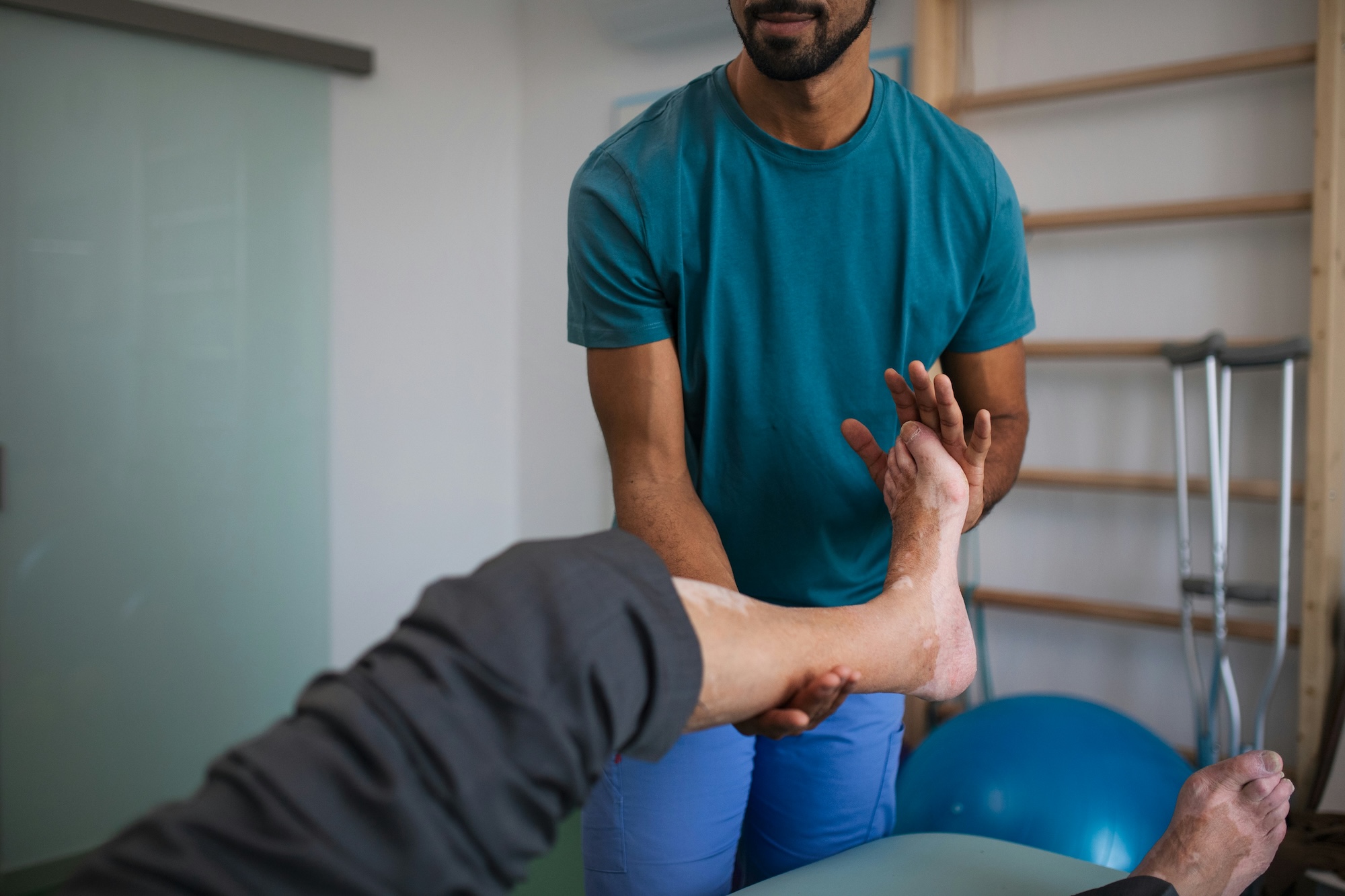
- Joint Mobilization: A physiotherapist uses hands-on techniques to help the small bones in the foot move smoothly again.
- Guided Stretching: Slowly stretching the calf muscles and the “heel cord” (Achilles tendon) prevents the joint from locking up.
- Gait Retraining: This simply means practicing how to walk with a “heel-to-toe” pattern again so you don’t develop a permanent limp.
Phase 3: Building “Protective” Strength
This is where many people stop their rehab because the pain is gone. However, pain-free does not mean “strong.” If you return to sports now, your ligaments are still soft and stretched out, making you a prime candidate for a re-sprain.
Strength is the ultimate protector of your joints. When the muscles around the ankle specifically the peroneals on the side and the calf muscles in the back are strong, they act like high-tension cables that catch the ankle before it rolls.
Key exercises often include:
- Calf Raises: Building the power needed to push off while walking or running.
- Resistance Band Work: Moving the foot outward against a band to wake up the stabilizing muscles.
- Step-Downs: Practicing controlled movements that mimic going down stairs or hills.
Phase 4: Training Your “Ankle Brain” (Balance)
Your joints have tiny sensors called proprioceptors that tell your brain where your foot is in space. When you sprain an ankle, these sensors get “short-circuited.” This is why your ankle might feel “lost” or uncoordinated after an injury.
Phase 4 is about “re-wiring” the connection between your brain and your foot. This is called neuromuscular training.
- Single-Leg Balance: This starts on flat ground and eventually moves to foam pads or “wobble boards.”
- Agility Drills: Practicing quick side-to-side movements and sudden stops.
- Reaction Training: Learning to stay stable even when something unexpected happens, like stepping on an uneven patch of grass.
Common Ankle Sprain Mistakes to Avoid
In Guelph, where winter ice and active summer sports keep ankles busy, it is important to avoid these common recovery traps:
- Relying on a Brace Forever: Braces are great “training wheels,” but your muscles eventually need to do the work themselves.
- Skipping the Hard Stuff: Balance training is boring compared to lifting weights, but it is the #1 way to prevent a second injury.
- Returning Too Fast: Feeling 90% better is a trap. That last 10% of strength and coordination is what protects you during a game or a long run.
Why Professional Assessment Matters
Every ankle sprain is different. Some involve small “avulsion” fractures, while others involve multiple ligaments or even the “high ankle” area. Ankle sprain treatment Guelph at Westwood Physiotherapy looks at more than just where it hurts. It looks at how you move, where you are weak, and how to get you back to your specific lifestyle safely.
Whether you are a soccer player, a trail runner, or you’re searching for ankle rehab near me, a structured plan ensures your ankle comes back stronger than it was before the injury. If your sprains keep repeating or your ankle feels unstable, our approach can also support longer-term chronic ankle instability treatment and return-to-play planning.
Book Ankle Sprain Treatment in Guelph Today
If you’ve recently rolled your ankle—or an old injury still feels weak—don’t wait for the next re-sprain.
Book your ankle sprain physiotherapy assessment at Westwood Physiotherapy in Guelph today and follow a structured plan designed to get you back to sport, work, and daily life with confidence.