Why Your Jaw Clicks: Understanding TMJ Dysfunction
You open your mouth wide to take a bite of your sandwich, and there it is again, that little click or pop right in front of your ear.
Maybe it doesn’t hurt at all. Maybe it’s accompanied by a dull ache along your jawline by the end of the day. Either way, your mind jumps straight to one place: TMJ, and you start wondering whether TMJ physiotherapy is something you actually need.
Here’s something worth knowing before you go any further down that worry spiral. Research suggests that up to 75 percent of the general population shows at least one sign of TMJ dysfunction at some point, most commonly a joint sound like clicking, and the vast majority of those people have no pain at all.
In other words, that click you just heard is common enough to barely raise an eyebrow on its own. At Westwood Physiotherapy, our Guelph based TMJ physiotherapy clinic, jaw clicking is one of the most frequent questions we field, and we’re here to help you figure out what your particular jaw is telling you.
What Is TMJ Dysfunction, Exactly?
TMJ stands for temporomandibular joint, which is the hinge and sliding joint that connects your lower jaw to your skull, just in front of each ear. You’ve got one on each side, and together they let you chew, talk, yawn, and make roughly a thousand tiny adjustments a day without ever thinking about it.
TMJ dysfunction (often shortened to TMD) is the umbrella term for problems affecting that joint, the muscles that move it, or both. It’s a genuinely common condition, with estimates suggesting somewhere between one in five and one in three adults experience some form of it. Women tend to be affected more often than men, and it typically shows up between your twenties and forties.
TMD isn’t one single problem with one single cause. It can involve the muscles of chewing becoming overworked and tense, the joint itself becoming irritated or inflamed, or the small disc of cartilage that cushions the joint shifting out of its usual position. That disc, as it turns out, is where most of the clicking comes from.
Why Does TMJ Dysfunction Cause Clicking?
Inside each TMJ sits a small, oval disc that normally glides smoothly between the jawbone and the skull every time you open and close your mouth. When that disc shifts slightly out of its ideal position, which can happen for a variety of reasons, it has to slip or pop back into place as you open or close. That slip is what you feel and hear as a click or pop.
Sometimes this disc displacement is accompanied by inflammation, muscle tension, or joint irritation, and in those cases the clicking shows up alongside pain, stiffness, or a jaw that feels like it’s catching or locking. That combination is a much clearer sign that something in the joint needs attention.
Clicking Doesn’t Automatically Mean You Have TMJ Dysfunction
This is the part that trips a lot of people up, so let’s be direct about it. A clicking or popping jaw, by itself, is not a diagnosis of TMJ dysfunction. It’s simply a joint noise, and joint noises are remarkably common in people with perfectly healthy, pain free jaws. Plenty of people go their whole lives with a jaw that clicks occasionally and never develop any pain or functional problem from it at all.
What actually tips a click over into a diagnosis of TMD is the company it keeps. If the click shows up alongside jaw pain, tenderness around the joint or nearby muscles, a jaw that feels stiff or restricted, difficulty chewing certain foods, or occasional locking where your mouth briefly won’t open or close all the way, that’s a very different picture than an isolated, painless click.
TMJ Dysfunction Doesn’t Always Cause Clicking
The reverse is just as true, and it’s just as important. Plenty of people with genuine TMJ dysfunction never hear a single click. A large portion of TMD cases are driven primarily by muscle tension and overuse rather than disc displacement, and those cases tend to show up as dull, aching pain around the jaw, temples, or ears, along with stiffness or fatigue when chewing, but no joint noise whatsoever.
So the click is neither required for a TMD diagnosis nor proof of one on its own. What matters is the full pattern of your symptoms, which is exactly why a hands on assessment is so useful rather than trying to self diagnose from a single symptom.
Common Contributors to TMJ Dysfunction
TMD is considered multifactorial, meaning it usually develops from a combination of things rather than one clear cause. Frequent contributors include:
- Clenching or grinding your teeth, especially overnight
- Ongoing stress or tension that settles into your jaw muscles
- Habits like nail biting, gum chewing, or resting your chin on your hand
- Poor neck and upper back posture, which changes how your jaw muscles have to work
- A past injury to the jaw or a hard impact to the face
How We Confirm What’s Going On
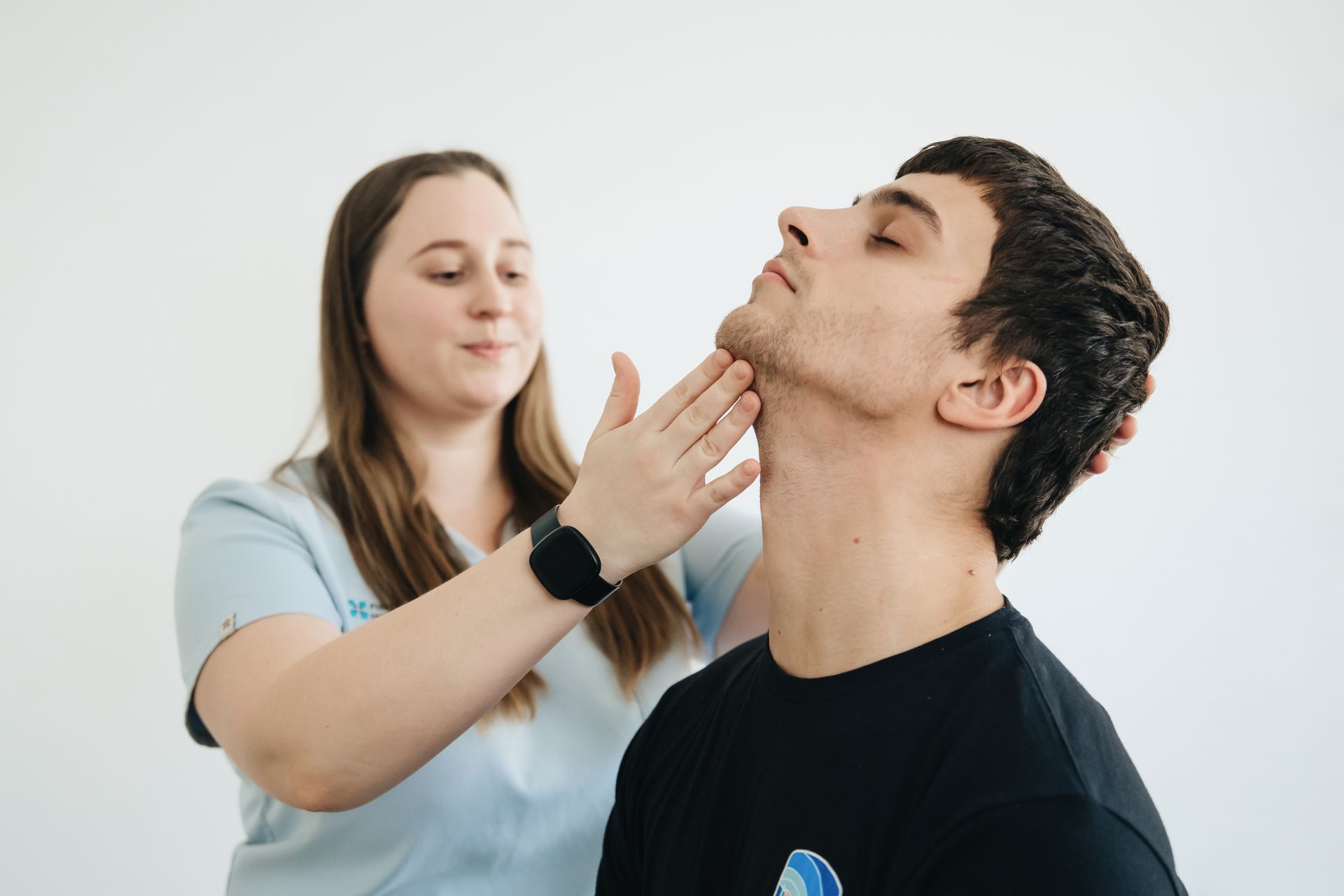
Because clicking alone doesn’t tell the whole story, a proper assessment looks at the bigger picture. That typically includes checking your jaw’s range of motion, feeling for tenderness in the joint and surrounding muscles, listening for the timing and quality of any joint sounds, and looking at your neck and posture, since the two are closely connected.
This clinical exam, guided by widely used diagnostic criteria for TMD, is generally enough to identify what’s driving your symptoms. Imaging such as an MRI is reserved for cases where symptoms are severe, persistent, or being considered for more advanced treatment, since it isn’t needed to confirm the more common, muscle driven presentations.
How TMJ Physiotherapy Helps
The encouraging news is that most TMJ dysfunction responds well to conservative, reversible treatment, and physiotherapy is a central part of that toolkit.
A typical plan might include gentle jaw range of motion exercises to restore smooth movement, manual therapy to release tension in the jaw and neck muscles, postural correction for your neck and upper back, and practical education on habits like clenching or nail biting that may be feeding the problem.
For many people, small changes like being more aware of jaw clenching during the day or adjusting a desk setup make a real difference alongside hands on treatment.
Recovery timelines vary depending on how long you’ve had symptoms and what’s driving them, but many people notice meaningful improvement within a few weeks of consistent treatment, and TMD in general tends to have a favourable, gradually improving course rather than a progressively worsening one.
When to See a Physiotherapist in Guelph
If your jaw clicks without any pain or restriction, there’s usually no need to worry about it. But if that click is accompanied by pain, stiffness, difficulty chewing, or occasional locking, or if you’re dealing with jaw pain without any clicking at all, it’s worth having it properly assessed rather than guessing at what’s causing it.
At Westwood Physiotherapy in Guelph, we help people sort out exactly what’s contributing to their jaw symptoms, build a plan that addresses the muscles, the joint, and often the neck and posture as well, and get you back to eating, talking, and yawning without a second thought.
Reach out to our Guelph clinic to book a TMJ assessment, and let’s get your jaw moving comfortably again.